
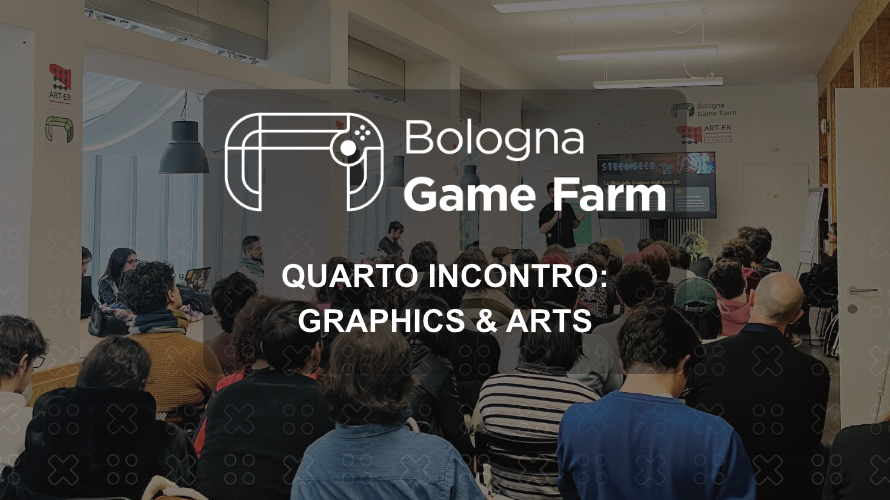
Another year of Bologna Game Farm has drawn to a close with a day entirely dedicated to graphics and art in video games. The event focused not only on the beauty of the visuals, but above all on the processes, choices and compromises that transform a visual idea into a tangible, professional game.
From art direction to animation, from UI to Unreal Engine 5 technology, the talks demonstrated how art in video games is never merely decoration, but the very backbone of the experience.
Mirko Mastrocinque – Creative process and direction: transforming ideas into hand-drawn 2D assets.
Mirko Mastrocinque opened the day by describing the journey from the aesthetic vision to the final realisation of hand-drawn 2D assets.
The focus of the talk was the role of art direction as an ongoing guide for the project: not a collection of isolated illustrations, but a coherent visual language that emerges from the concepts, is refined throughout production, and thrives through constant dialogue with the team.
Curating the style means making clear decisions on:
recurring shapes,
colour palettes,
level of detail,
emotional atmosphere.
These choices enable the creation of recognisable and sustainable worlds, avoiding the inconsistencies that inevitably arise in longer-running productions.
Carmine Cassese – Visual composition and UI: form, colour and tonal values in the service of readability and gameplay.
With Carmine Cassese, the focus shifted to the UI, which is often underestimated as a mere graphical ‘overlay’, but is in fact an integral part of gameplay.
The talk offered a practical introduction to the principles of composition as applied to the interface, demonstrating how:
shapes guide the eye,
tonal values improve readability,
colour communicates hierarchies and priorities.
Through concrete examples and common pitfalls, Cassese outlined a clear pipeline for integrating art, UX and technical development, emphasising that a good UI goes unnoticed: it works, guides and supports the experience without ever stealing the limelight.
Roberto Semprebene – Nanite and Lumen in action: redefining production with Unreal Engine 5.
Roberto Semprebene spoke about one of the most hotly debated topics of recent years: Unreal Engine 5 and its impact on production thanks to Nanite and Lumen.
These technologies have radically changed the way we think about assets, lighting and workflows, reducing some long-standing complexities whilst introducing new ones.
Using the STEEL SEED case study, Roberto Semprebene demonstrated how to integrate these innovations into a real-world pipeline, highlighting that technology is never neutral: every technical advancement directly influences artistic and production decisions.
Massimo Gentili – Creating Cinematics: Animation in Video Games.
Massimo Gentili’s talk explored the world of cinematics, outlining the complete workflow:
analysis of the brief,
drawing up the schedule,
putting the team together,
managing the production stages.
Particular attention was paid to quality control tools, which are essential for maintaining consistency and quality throughout the entire production process.
When well-integrated, cutscenes are not merely spectacular interludes, but narrative moments that reinforce the game’s identity and pacing.
Daniele Pezzella – Animation and game experience: tips for a truly professional animation pipeline.
Daniele Pezzella addressed the topic of animation from the perspective of day-to-day production, focusing on the nuances that distinguish amateur work from professional work.
Every decision relating to animatable assets — rigs, proportions, naming conventions, structuring — has a knock-on effect across the entire pipeline.
The talk outlined a series of best practices for improving aesthetics and efficiency, emphasising that animation is never a silo, but an element that constantly interacts with design, programming and performance.
Federico Ferrarese – “Chiaroscuro”: the artistic direction of an all-Italian soulslike
The talk by Federico Ferrarese, art director of *Enotria: The Last Song*, traced the history of the project and the creative and technical choices that shaped its visual identity.
This in-depth analysis, packed with examples and practical solutions, demonstrated how to build a strong artistic vision by drawing on references and elements from Italy’s cultural heritage, adapting them to a codified genre such as the ‘soulslike’ without losing originality.
Ivan Maestri – Creating worlds with minimal resources: strategies and solutions for bringing ambitious projects to life.
To round off the day, Ivan Maestri spoke about the indie development of Stonemachia, a 3D project inspired by Italian art and architecture.
The focus of the talk was on creative optimisation: how to create a well-made, professional-quality game with minimal resources.
The answer lies in a consistent and streamlined art direction, in the ability to learn from mistakes, and in knowing how to make drastic yet coherent choices.
A powerful reminder for those developing on a shoestring budget: ambition should not be discarded, but channelled.
In conclusion
The final day of the 2025 edition of Bologna Game Farm demonstrated that art in video games is not merely about aesthetics, but about process, method and a shared vision.
Whether the focus was on UI, animation, technology or art direction, the common thread remained the same: every visual choice has a direct impact on the production and identity of the project.
An ideal finale to a year that has explored video games in all their forms: as a creative work, as a product and as a tangible profession.