
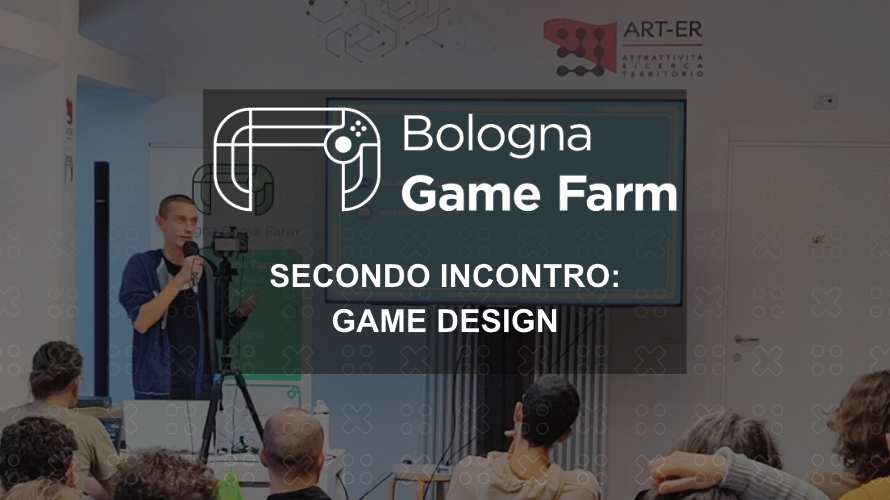
As usual, the Greenhouses at the Giardini Margherita hosted the Bologna Game Farm event dedicated to game design. A full day of meetings and talks demonstrated that game design is a balance between creativity and method.
DESTINYbit: Product-Oriented Design, the intersection of game design and art direction
Instantly recognizable and incredibly appealing: that’s what the fantasy world that sells the game must be like. With this sentence, Gian Paolo Vernocchi sums up the core of his talk.
Today, on platforms like Steam, what sells is the fantasy the player wants to experience. Not the originality of the gameplay itself, but the experience imagined based on its art style, title, price, and genre.
According to Vernocchi, game design and art direction aren’t two parallel paths, but a circular process in which each influences the other with the goal of creating the game’s appeal. Every aesthetic choice carries with it expectations and “costs”: a dark RTS suggests complexity and commitment, while a low-priced economic simulator is expected to offer a less polished experience.
It all comes down to the difference between MVP (Minimum Viable Product) and MLP (Minimum Lovable Product): the former is a functional product; the latter, however, is not only functional but also capable of generating love and engagement among the audience.
How can this be achieved? Define the game’s pillars, never stray from them, and continuously iterate while asking yourself:
What kind of fantasy experience am I offering players?
Do my design and art direction truly work together?
Can I explain my game with a GIF?
Because, as Vernocchi pointed out, video games are products that are purchased—and as such, they will be judged.
Pietro Guardascione: Progression and Balance: 5 Lessons from Economy Design
How much content does a game need to work?
That was the question Pietro Guardascione started with, highlighting how progression is one of the most complex and underrated systems to design.
Categories alone (“a management sim,” “a roguelite”) aren’t enough; you need precise benchmarks and a detailed study of real video game examples. Every design choice comes at a cost in terms of content, time, and resources.
That’s why Guardascione urges developers to simulate progression before implementing it—even if it’s just in a spreadsheet—to answer questions in advance such as:
How long does the game last?
How much does the player’s power grow?
Only in this way can you prevent structural problems that emerge too late in development.
Guardascione’s final piece of advice? Mistakes will always happen, but if you’ve simulated your system, you’ll know how to recognize and address them.
Demon Girl Digital: Modular Design. A Method and Philosophy for Surviving Any Scenario
Fabio Consorti offered valuable insight for those working in small teams or indie studios: think in a modular way.
A modular design allows a game to adapt to whatever the future of video game development may hold: expanding, shrinking, or changing form without losing coherence.
Weapons and abilities as plug-in blocks, enemies based on modular behaviors, and small, separate scripts. With these building blocks, a project becomes resilient to the unexpected.
Each module must be a self-sufficient ecosystem: it stands on its own, but works best as part of a network.
This approach not only simplifies working with external collaborators but also makes it easier to manage expansions and post-launch content.
Broken Arms Games: Game Pillars and Management Games. From Identity to Game Coherence
For Yves Hohler, design pillars are the compass that guides every development decision.
The example of *Hundred Days* illustrates this: it’s a video game from the studio in which the player must manage a vineyard. To portray the world of wine, the team had to study how wine is perceived globally and discovered that, outside of Italy, wine is associated with France.
In *Under Par*, the studio’s recent golf course management game, one of the pillars was nostalgia: it wasn’t meant to evoke *SimGolf* itself, but rather the memories players had of that game.
Hohler recommends looking to the zeitgeist—the spirit of the times—to find relevant themes. Observe and study Netflix, Facebook, and Amazon to understand where the world of entertainment is headed.
It’s better to have a few clear pillars than too many. However, development is an evolving structure, not a set of dogmas to be followed obsessively.
Mattia Pastorino: Game Mechanics: From Theory to Practice
Mattia Pastorino highlighted the MDA theory: Mechanics, Dynamics, Aesthetics. A few strong mechanics are worth more than many weak ones.
Creating a reusable modular framework, testing early and often, and defining the pillars from the outset are the keys to coherent and flexible game design.
Replayability stems from the interaction between mechanics and dynamics, while aesthetics translates all of this into emotion and identity.
Alessandro Ricci: Idea vs. Prototype. Creativity, Data, and Method in Indie Game Design
Alessandro Ricci wraps up the day with a reflection on methodology and data in indie game development.
The modern era of game design, he says, is dominated by rapid prototyping thanks to modern engines, but this also requires analytical rigor.
Ricci encourages working outside the game engine, creating and testing formulas and logic in spreadsheets, using a data-driven approach. Through operational research, designers can set up algorithms and then adapt them to the data, optimizing paths, progression, and balance.
Automating processes and filtering ideas thus becomes an integral part of the craft. Game designers don’t have to do everything, Ricci concluded, but they must know what really matters to make the project work.
In conclusion
This latest acceleration day at Bologna Game Farm has shown once again that making video games today means creating solid, desirable experiences—but also designing them methodically and with a clear understanding of the product.
Whether it’s a wine management sim, a modular roguelite, or an experimental indie game, the message remains the same: video games are dreams, and they should stay that way, but they also need to be crafted to the highest standards as products.