
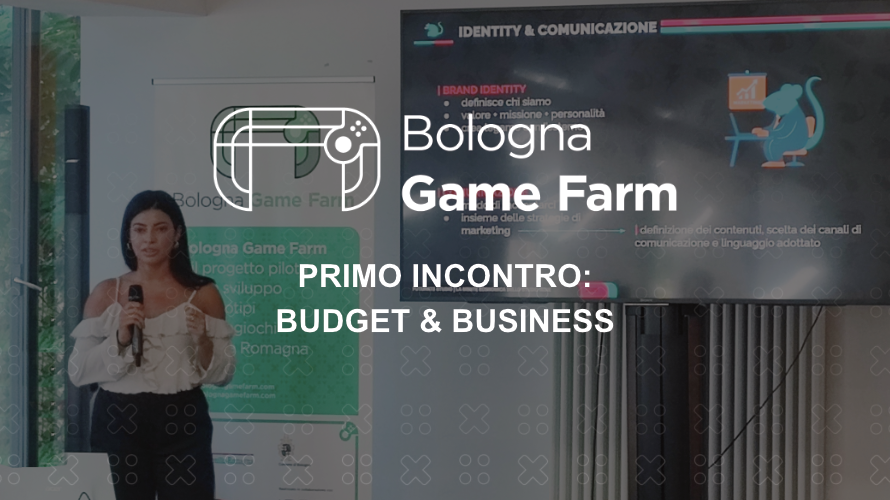
The first day of the acceleration program for the fifth edition of Bologna Game Farm, held on Friday, September 19, 2025, at the Serre dei Giardini Margherita, continued the approach established in the fourth edition by opening the event to the region’s entire gaming ecosystem: professionals, students, and enthusiasts from the general public, in addition, of course, to the winning teams.
It was a day of intense and in-depth work on budgeting and business, with presentations held throughout the day.
The morning began with a presentation by Fabio Dell’Erba of Digital Moka, a studio specializing in the publication of mobile video games.
Fabio Dell’Erba – Digital Moka: Mobile Publishing: Challenges and Opportunities in the Mobile Gaming Market.
Fabio Dell’Erba explained how this continuously growing sector works: in 2024, the global gaming market reached $187 billion, with nearly half (49%) coming from mobile games. This ecosystem relies primarily on the Google Play Store and the Apple App Store; it is highly competitive yet rich in opportunities, especially in emerging markets where consumer behavior differs from that of PC or console gaming.
Finding Your Niche in the Market
Each mobile genre appeals to different audiences, with varying patterns of loyalty and spending: some players remain loyal to a title for months, while others tend to spend more on in-app purchases. For developers, there are two paths: aiming for the so-called “unicorn”—a title that takes off organically—or building solid games that still need an extra boost through user acquisition campaigns.
ARM – Acquisition, Retention, Monetization
Dell’Erba summarized mobile gaming strategies using the ARM formula:
Acquisition: raising awareness of the game and encouraging players to download it. This can be achieved through external channels (in-app or search advertising, social media marketing, influencers) or internal channels (optimizing assets such as graphics and descriptions, SEO, cross-promotion among games from the same studio, “member-get-member” programs). However, performance analysis is essential: key metrics such as CPI (Cost per Install), LTV (Lifetime Value), and ROAS (Return on Ad Spend) measure the actual effectiveness of campaigns.
Retention: convincing users to stay. “A good game isn’t enough,” explained Dell’Erba: you need new content, frequent rewards, in-game events, as well as external activities such as push notifications and social media content. Retention rates vary by genre, but retaining 45% of users on Day 1 is already considered an excellent result.
Monetization: turning time spent into revenue. The main models are premium (direct purchase of the game), free-to-play with ads, and freemium (in-app purchases). In practice, many titles adopt a hybrid model. Key metrics to monitor here include ARPU/ARPDAU (Average Revenue per User/Daily Active User), IAP penetration rate (often only 3% of players pay, but they must support all the others), and time to first purchase.
The Importance of the Testing Cycle
Fabio Dell’Erba concluded with a practical tip: “Don’t be afraid to test on a small scale.” Low-budget campaigns allow you to gather valuable data before scaling up your investments in a sustainable way. The winning strategy remains the same: test > analyze > imp
Marco Minoli – Slitherine: PC Publishing, Budget Management, and Sustainability
After the session on mobile gaming, it was Marco Minoli’s turn to speak. He is the director of publishing at Slitherine, a company that has been dedicated to PC strategy games for over 25 years.
Minoli described how the market has changed profoundly over the past two decades: today, most of the industry’s revenue comes from mobile and the free-to-play model, which is also present on PC and consoles. However, the premium PC/console market has remained surprisingly stable: those seeking complex, niche experiences continue to seek them out, albeit at different costs than in the past.
The Value of Sustainability
For Slitherine, the key word is sustainability. The goal isn’t to create a single title that burns out in a few months, but to build a lasting franchise: the base game becomes a platform on which to develop DLC and additional content. It’s not just about extending the game’s lifespan, but about tapping into a behavior typical of the strategy gaming audience: collecting. Those who love a title tend to want all available content, even if they won’t use it right away.
This approach keeps costs manageable by spreading development over time and offering continuous value to the community.
Tips for Developers
Marco Minoli shared some practical tips for those looking to break into the market:
Start small: don’t aim for games that are too big and complex right away.
Manage your ambitions: a solid, focused title is better than an unmanageable project.
Think in a modular way: for example, start with a story mode and add the rest—skirmish, multiplayer, or other components—later.
Be patient: Building a franchise takes time, iterations, and the ability to learn from what’s already been done.
System-based game design
A key strength of strategy games is their system-based nature: rules and mechanics that interact with one another create endless variations and lend themselves well to being expanded with subsequent modules. This is the key that allows Slitherine titles to grow over time without losing coherence.
Luca Vajani: Developing a WEB3 Video Game, from Gameplay Progression to Monetization.
The third presentation of the day was held by Luca Vajani of Cathedra, who brought a different perspective to the stage: that of Web3 games and blockchain integration.
Vajani presented Quantum Command, a third-person shooter developed in Unity that integrates certain game modes with NFTs and digital tokens. The underlying logic is clear: a token is a digital currency, while NFTs serve as unique certificates of ownership for virtual assets, such as weapons or skins. Since the blockchain is public, it guarantees the validity of ownership even outside the individual game. In theory, a purchased item could be transferred from one game to another, paving the way for new forms of player retention and monetization.
Long-Term Value and Incentives
The underlying idea is that digital ownership creates incentives for both players and developers. If an item has real value and can be traded in a peer-to-peer economy, players are more likely to invest time and money in the project, while developers can count on more stable community engagement.
For this to happen, however, the blockchain must be an added value rather than a constraint. Without solid gameplay, crypto mechanics risk remaining nothing more than a off-putting label.
The Architecture of Web3 Games
A Web3 game does not differ much from a traditional game in its basic client-server structure, but it integrates additional elements such as:
- NFTs and internal marketplaces,
- fiat/crypto bridges to facilitate user onboarding,
- smart contracts for secure transaction management.
In addition to the standard roles, the development team must include specialists such as blockchain developers, smart contract auditors, tokenomics designers, and community/marketing managers capable of engaging with very diverse audiences: some are interested only in the game, while others are interested only in the crypto aspect.
Models and Strategies
The reference models range from “play-to-earn” (focused on profit, but often unsustainable in the long term) to the more balanced “play-and-earn,” which also prioritizes fun. Retention strategies are similar to those used in mobile gaming: daily rewards, events, and artificial token scarcity to increase their value.
Mistakes and Challenges
Vajani warned against some common mistakes:
- overly complex onboarding, with cumbersome wallets and procedures,
- a lack of fun, with the risk that the focus remains solely on speculation,
- and the very use of the terms “crypto” and “NFT,” which tends to scare off traditional publishers and players.
It’s no coincidence that platforms like Steam have removed Web3 games, while the Epic Games Store accepts them. Other emerging marketplaces include Hyperplay, Xterio, and the Immutable ecosystem dedicated to blockchain gaming.
Community and Marketing
Web3 marketing follows its own logic: the primary channels are Discord and X (Twitter), where communities not only discuss but often actively participate in development through feedback, collaborations, and events. NFTs can also become engagement tools, for example as “tickets” to access closed betas or exclusive drops.
Security and Regulation
Finally, Vajani emphasized the importance of compliance: anti-money laundering systems, distinguishing between tokens usable only in-game and those spendable externally, and adherence to digital market regulations are essential for anyone who wants to operate seriously in this sector.
Maya Tardito – Futurats: The financial brain behind the indie studio, the importance of administrative and commercial matters
The day at Bologna Game Farm continued with a talk focusing on economic and strategic aspects. Maya Tardito from Futurats spoke about something that is often overlooked in indie projects: the financially sustainable and administrative management of the studio.
The company is the product
The first shift in perspective proposed by Tardito is clear: one should not view the individual video game as the heart of the project, but rather the company itself as the product. Only in this way can one ensure continuity, stability and a future for one’s creative work.
Structure and identity
One of the most suitable options for emerging developers is to set up as an innovative start-up, which can also be done online and provides access to tax breaks and dedicated funding schemes. However, setting up a company is only the beginning: certain fundamental pillars need to be clearly defined:
Mission: what am I doing right now? What is my specific role today?
Vision: where do I want to be in the medium to long term as a business?
Business model: how can I generate revenue sustainably?
Planning and objectives
To give substance to the vision, it is necessary to set objectives across different time horizons:
Short term: within 12 months, concrete and measurable actions.
Medium term: developments spanning several years, such as new markets or parallel projects.
Objectives must be accompanied by performance indicators – tools that enable us to assess whether the company is growing in the right direction.
Sustainability and calls for proposals
A key issue is sustainability. Not all calls for proposals are the same: before applying, it is important to check not only the eligibility criteria but also the expenditure requirements. Managing certain grants could prove excessively complex for companies that are still small.
Outsourcing and B2B
Finally, Maya Tardito emphasised the value of parallel activities such as outsourcing services or business-to-business work. This revenue can help sustain the company during the most difficult times, but it must never cause you to lose sight of the main objective: developing video games and growing the creative brand.
Michele Caletti – Milestone: Production of AA and AAA video games, from licence management to cost control
The next presentation featured Michele Caletti, game director at Milestone, the long-established Milan-based studio known for racing titles such as MotoGP. His talk demonstrated how, behind the passion for motorsport and gameplay, there lies an extremely structured and rigorous working method.
The Milestone Method
For Milestone, success stems from a balance between key roles filled by passionate individuals and precise business management. The studio often works on several titles simultaneously, maintaining high quality standards thanks in part to the development of proprietary technologies.
Controlling timeframes and costs is fundamental: with a franchise such as MotoGP, the release date is fixed and cannot be postponed. In fact, the development of an annual title is based on very tight deadlines: around ten months of production, with the need to have up-to-date bikes and teams ready at launch, despite there being only a two-month window following the official reveal of the real-world season.
Furthermore, working with a licence requires that all content be approved by the licensor.
This is compounded by the fact that the game’s audience consists of two distinct groups: core fans, who demand a deep and realistic simulation, and casual players, who prefer a more accessible approach.
For this reason, the studio adopts an adapted Agile approach, using tools such as Jira and Tempo to track tasks and timesheets.
The process begins with initial planning (project scope), followed by a detailed breakdown, fortnightly sprints, feasibility checks and constant interaction between the game director, project manager and department heads, who reallocate resources according to priorities.
New features are planned well in advance, with the aim of maintaining a balance between these requirements.
Screamer: a new type of project
Alongside its sports series, Milestone is developing Screamer, a narrative-driven racing game set in an anime/cyberpunk universe. Unlike MotoGP, it is not tied to a real-life championship: the cars and tracks are original, the characters are styled after Japanese animation, and the plot does not focus exclusively on sporting victory.
Consequently, development also follows a different process, less constrained by tight deadlines. The production schedule is marked by clear milestones:
2022: concept development
2023: internal approval of the project
2024: official announcement and start of collaboration with the animation studio Polygon Pictures
2025: production phase, from the vertical slice to the final version
The team comprises around 60 in-house developers, supported by the animation studio Polygon Pictures and external partners. The game aims to appeal both to those who appreciate the immediacy of arcade racing and to those interested in a more narrative-driven experience. To support this, internal and external playtests are carried out, along with mock reviews by journalists, which are useful for gauging public perception of the title in advance.
Advice for developers
Caletti concluded with some personal insights for those wishing to become video game developers:
Be eclectic: explore different cultures, arts and languages; step outside your comfort zone.
Maintain your vision: communicate objectives clearly, but give the team the freedom to grow.
Leave no room for fear or anger: these emotions hinder creativity.
Remember that it’s a journey: there’s no final destination; there’s always something new to learn and build.
Eleonora Vecchi and Cristian Gambadori – Bad Vices: Self-publishing on Steam, the quest for the right product.
The Bologna Game Farm event drew to a close with a talk by Bad Vices, an independent studio based in the Marche region, which shared its experience of self-publishing.
The pros and cons of self-publishing
Self-publishing means having complete control over the project and the ability to operate with great agility, without intermediaries. Furthermore, all revenue remains with the studio. But this freedom comes at a cost: all development, marketing and event costs fall on the team, and the risk of failure weighs heavily not only financially but also emotionally.
Attending trade fairs and reaching out to the press and creators becomes more challenging without the support of a publisher. This is why Bad Vices emphasised that self-publishing is only advisable if the team is able to cover most of the necessary skills in-house.
Strategic choices
A crucial step is choosing the genre: not all projects are suited to the budget or scale of a small studio. It is important to constantly monitor new releases on Steam, create customised lists and observe what other developers are doing.
Equally crucial is recognisability: a game must be immediately understandable from the capsule image, the thumbnail representing the title in the store.
Budget, Timelines and Ambitions
The Bologna Game Farm event drew to a close with a talk by Bad Vices, an independent studio based in the Marche region, which shared its experience of self-publishing. Every extra month of development represents an additional cost, and there is no guarantee that a long-running project will still be relevant by the time it is released. An ambitious game is not always a feasible project: Bad Vices explained how, during the development of *While We Wait Here*, the volume of assets had been underestimated, resulting in six months of extra work. The voice-over work also proved to be much more costly than anticipated.
Hence the advice: it’s better to have more ‘bullets’ (smaller, more diverse projects) than to put all your eggs in one basket.
A choice to be made at the outset
Finally, Bad Vices emphasised that self-publishing is not a decision to be taken lightly or partway through the process: it must be planned from the very start of development, aligning the team’s skills with market demand. Only then does it become a well-informed strategy rather than a leap into the unknown.
From major studios like Milestone, with their structured processes, to the independents at Bad Vices, who are experimenting with the risks and freedoms of self-publishing, the day at Bologna Game Farm demonstrated just how much the video game industry is made up of diverse approaches, yet united by a shared passion.
However, this passion must be accompanied by planning, creative vision and an awareness of one’s own resources, regardless of the size of the practice or the ambition of the project.